Only verified buyer and supplier
How is the Sampling Process Managed in Textiles?
/
6-Minute Read
Discover the sample types, the approval process, and the transition to mass production step by step.
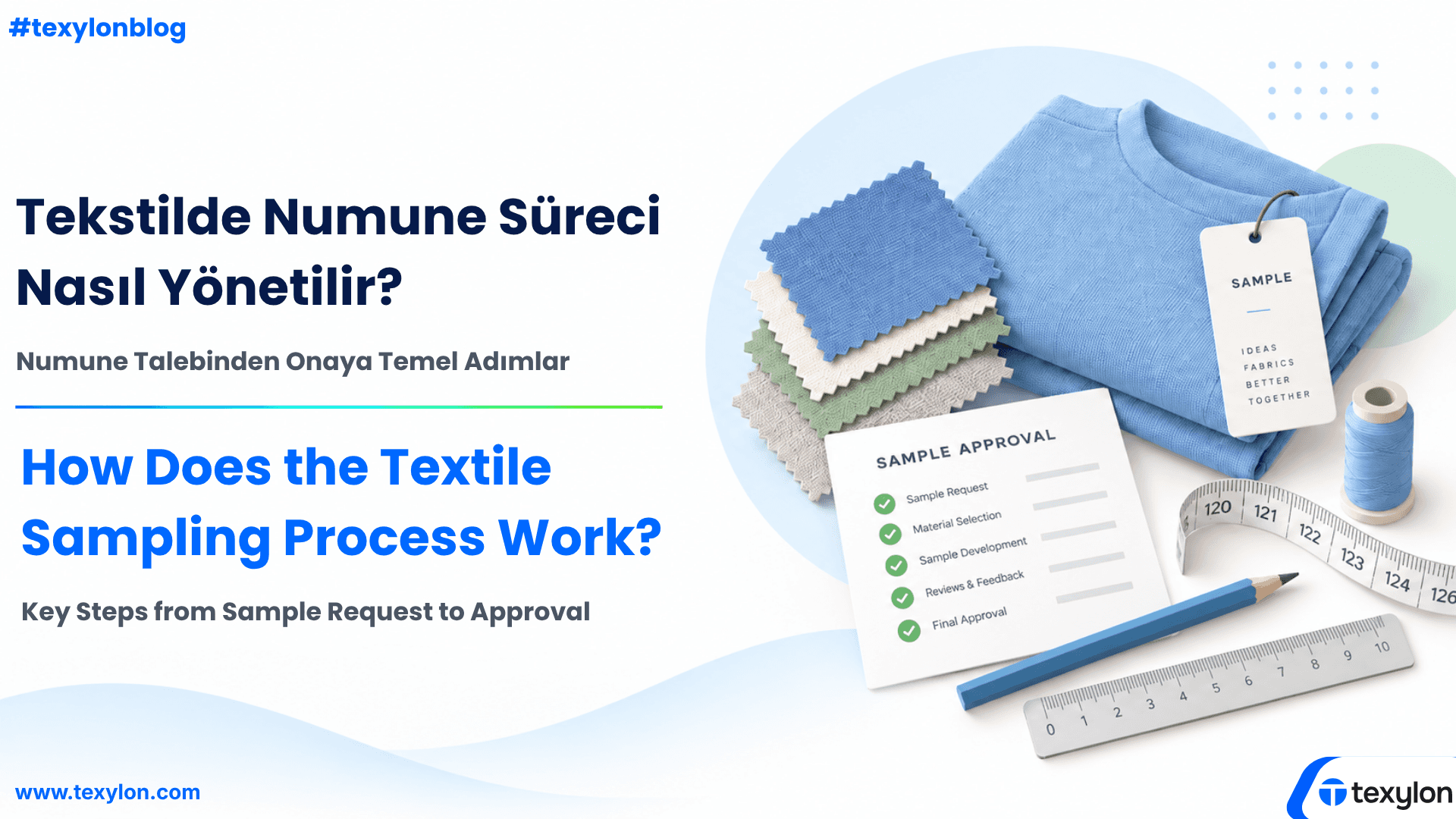
How to Manage the Sampling Process in Textiles?
In the textile industry, the transition of a product from the conceptual phase to mass production does not usually begin with a direct order. One of the most critical stages between the buyer and the manufacturer is the sampling process.
Numerous elements, including fabric texture, color accuracy, product dimensions, printing or embroidery details, accessories, and workmanship, are evaluated through a sample before mass production commences. Therefore, a well-managed sampling process is essential not only to verify the appearance of the product, but also to minimize misunderstandings, unnecessary revisions, costs, and production delays.
How, then, does the sampling process proceed in textiles? What information should the buyer provide to the manufacturer, and what factors must be considered during sample approval?
Why is Sampling Crucial in Textiles?
The sample serves as one of the most critical control points, ensuring that both the buyer and the manufacturer share a mutual understanding of the product.
Even if a product is accurately described in the technical documentation, the tactile feel of the fabric, the appearance of the color in a real environment, or whether the final form of the product meets expectations can only be reliably evaluated through a physical sample.
Through the sampling process, the buyer is enabled to:
• evaluate product quality,
• inspect fabric and material selection,
• verify colors and dimensions,
• examine printing, embroidery, and accessory details,
• identify necessary modifications prior to mass production.
For the manufacturer, the sample facilitates a clearer comprehension of client expectations and allows for the preemptive identification of potential production errors.
Consequently, a sample is not merely a product prototype; it represents the mutual reference point prior to mass production.
What Information Should Be Provided When Submitting a Sample Request?
The efficiency of the sampling process depends significantly on the clarity of the initial request.
Rather than a generalized request such as "I require a product similar to this," it is essential to share as much measurable and technical data as possible.
Depending on the product, a sample request may include the following information:
• product or fabric type,
• material and composition,
• fabric weight (GSM),
• color or Pantone code,
• dimensions,
• printing or embroidery details,
• accessories to be utilized,
• labeling and packaging expectations,
• required certifications,
• estimated order quantity,
• target delivery date.
Particularly when collaborating with a new manufacturer, visual references, technical drawings, or an existing product specimen can facilitate communication considerably.
At Texylon, clearly communicating product specifications and sampling expectations from the outset when establishing contact with the suitable manufacturer can significantly enhance process efficiency.
A sample request can also form the foundation of a subsequent purchase request. You may examine the RFQ process, which enables buyers to collect pricing and production data from manufacturers systematically, in greater detail in our article What is an RFQ in Textiles?.
What Are the Sample Types in the Textile Sector?
Not all samples are prepared for the same purpose. Various samples may be utilized depending on the product type and stage of development.
A development sample is the initial physical iteration of the product concept. At this stage, the primary objective is generally to evaluate the design and materials fundamentally.
A fit sample is prepared specifically for apparel to assess the pattern, sizing, and drape of the product on the body.
A size set sample is utilized to verify whether the product is accurately scaled across different sizes.
A color sample or lab dip assists in verifying the requested color prior to production.
A pre-production sample is prepared as close to the final production run as possible before mass manufacturing begins. The majority of details, including fabric, color, accessories, labels, and workmanship, must be finalized at this stage.
Not every project will require all of these sample types. The process may vary according to the product type, order volume, and the buyer's quality control procedures.
How Does the Sample Development Process Proceed?
A typical sampling process comprises several fundamental stages.
Initially, the buyer shares the product specifications with the manufacturer. The manufacturer evaluates this data and determines the feasibility, approximate cost, and lead time for sample preparation.
Subsequently, the initial sample is manufactured and dispatched to the buyer.
Upon evaluating the sample, the buyer conveys any revision requests to the manufacturer. It is imperative that feedback at this stage is as precise as possible.
For instance, rather than stating "let us make the color slightly darker," providing a reference color code, or instead of stating "the garment is somewhat loose," specifying which dimension requires adjustments in centimeters, will yield far more effective results.
Following the necessary adjustments, a revised sample may be prepared. Once the product meets the specified expectations, final approval is granted to commence mass production.
Although the process appears straightforward, inadequate information sharing can result in multiple sampling rounds and weeks of delays.
What Should Be Considered During Sample Approval?
When evaluating a sample, examining merely the general appearance of the product is insufficient.
Although inspection criteria vary by product category, it is beneficial to evaluate the following fundamental areas:
Fabric and material: Have the requested composition, weight, and texture been utilized?
Color: Is it consistent with the approved color standard?
Dimensions: Are the technical measurements and tolerances correct?
Workmanship: Are the stitching, seams, finishing, and other manufacturing details of acceptable quality?
Printing and embroidery: Do the placement, colors, and dimensions meet expectations?
Accessories: Are zippers, buttons, labels, or other trims correct?
Packaging: If included in the scope of the sample, does it conform to the requested packaging details?
If specific environmental or product safety standards are required for the product, it is critical to clarify requirements regarding textile certifications such as OEKO-TEX®, GOTS, and GRS with the manufacturer during the sampling stage.
How Can Sample Revisions Be Minimized?
It is common to undergo one or more revisions during the sample development phase. However, the continuous emergence of new modifications can result in a loss of time and increased costs for both the buyer and the manufacturer.
The most effective method to mitigate this is to compile the initial sample request with as much detail as possible.
It is also critical that feedback from all internal teams is consolidated and communicated to the manufacturer via a single document or channel. Conflicting requests received from different parties at various times can cause confusion.
Furthermore, it is highly beneficial to maintain a record of which details have been modified and which have been approved during each revision.
A competent manufacturer will not merely follow instructions, but will also proactively advise the buyer regarding details that may be technically challenging to execute or that may escalate costs.
In the sampling process, the manufacturer's technical capability, quality standards, and reliability are as vital as clear communication; therefore, selecting the appropriate textile supplier is one of the most critical initial steps in the process.
Are Sample Charges Applicable?
Yes. In the textile industry, manufacturers are not obligated to provide samples free of charge.
Particularly if custom fabric sourcing, new pattern development, or specialized printing, embroidery, or custom accessories are required, the manufacturer may request a sampling fee.
While some manufacturers may deduct this cost from the subsequent bulk order, others may invoice sample and shipping charges separately.
Consequently, it is advisable to clarify the following points prior to commencing sample development:
• the sample fee,
• shipping costs,
• estimated lead time,
• the number of included revisions,
• whether the sample fee is deductible upon order placement.
Order volume can also influence a manufacturer's approach to a project. If you wish to understand how minimum order quantities are determined, you may consult our article What is MOQ in Textiles?.
Transitioning from Sample Approval to Mass Production
The approval of the final sample represents a significant milestone, yet the process is not entirely complete at this stage.
Prior to commencing mass production, it must be explicitly defined which sample the manufacturer will reference. Fabric, color, size charts, accessories, labels, and packaging specifications must be verified one final time.
Where feasible, it is beneficial for one copy of the approved sample to remain with the manufacturer while another is retained by the buyer.
This ensures that once mass production is complete, the final goods can be evaluated against the identical reference point.
Particularly within the private label manufacturing model, brand labels, custom packaging, accessory selection, color, and other product-specific details must be finalized before mass production. Therefore, the sampling phase is a critical step, not only to approve the general aesthetic of the product, but also to ensure that all brand-specific details are accurately integrated into production.
How Can Digitalization Facilitate the Sampling Process?
Although a sample is a physical product, a significant portion of the process can be managed digitally.
Identifying the suitable manufacturer, sharing technical specifications, submitting RFQs, evaluating price quotations, and communicating with the manufacturer can become highly systematic through the use of digital tools.
Particularly in international sourcing processes, considering the distance between the buyer and the manufacturer, the accurate transmission of expectations at the initial stage is of paramount importance.
Texylon aims to enable textile buyers, manufacturers, and suppliers to discover one another more easily, establish new business connections, and streamline their sourcing operations.
A well-defined sampling process that commences with the appropriate manufacturer ensures a more secure and efficient path to mass production.
Conclusion
The sampling process in textiles involves far more than merely viewing a prototype of the product. It represents a vital development stage wherein expectations between the buyer and the manufacturer are aligned, technical details are validated, and risks prior to mass production are mitigated.
Preparing a detailed sample request, partnering with the correct manufacturer, conveying feedback transparently, and archiving final approvals ensures a faster and more efficient process.
In international textile trade, communicating product expectations precisely is as fundamental to a successful sourcing process as identifying the correct business partner.
With Texylon, you can discover manufacturers and suppliers in the textile sector, establish new business connections, and manage your sourcing opportunities through a single platform.
Frequently Asked Questions
How long does the textile sampling process take?
The duration varies depending on the product type, materials utilized, manufacturer capacity, and the number of revisions. While a basic sample can be prepared within a few days, projects requiring specialized fabrics, accessories, or extensive development may take longer.
Is sampling always subject to a fee?
No. While some manufacturers may offer complimentary samples, fees may be requested in instances involving custom manufacturing, pattern development, printing, embroidery, or specialized material sourcing.
How many sample revisions can be performed?
There is no fixed limit. However, the precision of the initial request directly influences the number of revisions required. Sharing clear technical specifications and measurements shortens the process.
Can modifications be made to production after a sample has been approved?
Modifications can be made; however, once mass production has commenced, changes may incur additional costs and result in delays. Consequently, it is highly recommended to finalize all details during the sampling stage.
Can there be discrepancies between the sample and the mass-produced item?
Minor manufacturing tolerances may occur, but mass production is expected to conform as closely as possible to the approved sample and technical specifications.
Is a sample necessary in private label production?
In most cases, yes. It is particularly critical to verify brand labels, packaging, accessories, color, and other customizations on a sample prior to mass production.


