Only verified buyer and supplier
What Is an RFQ in the Textile Industry?
/
6-Minute Read
Digital Quote Management Accelerating the Procurement Process
The Era of Digital Procurement in the Textile Industry Has Begun
Identifying the correct supplier, obtaining competitive pricing, and collaborating with reliable manufacturers are becoming increasingly critical in the textile industry. The expansion of global supply chains, volatility in production costs, and escalating competition necessitate that procurement teams make faster and more precise decisions.
Today, numerous textile enterprises continue to manage their bidding processes via email, Excel files, WhatsApp communications, and telephone calls. However, these methods result in significant time losses and introduce inefficiencies into the procurement operations.
At this precise juncture, the Request for Quotation (RFQ) process becomes essential. Through digital RFQ management, enterprises can transmit their requirements to hundreds of suitable suppliers simultaneously, compare bids in a standardized format, and manage procurement processes in a highly professional manner.
TEXYLON, a global B2B textile sourcing platform developed specifically for the textile industry, digitalizes the RFQ process and connects buyers and manufacturers from various countries across the globe on a single platform.
What is an RFQ (Request for Quotation)?
An RFQ (Request for Quotation) is a procurement process in which a business solicits formal price quotations from suppliers for required products or services.
The RFQ system is one of the cornerstones of procurement processes, particularly within the manufacturing sector.
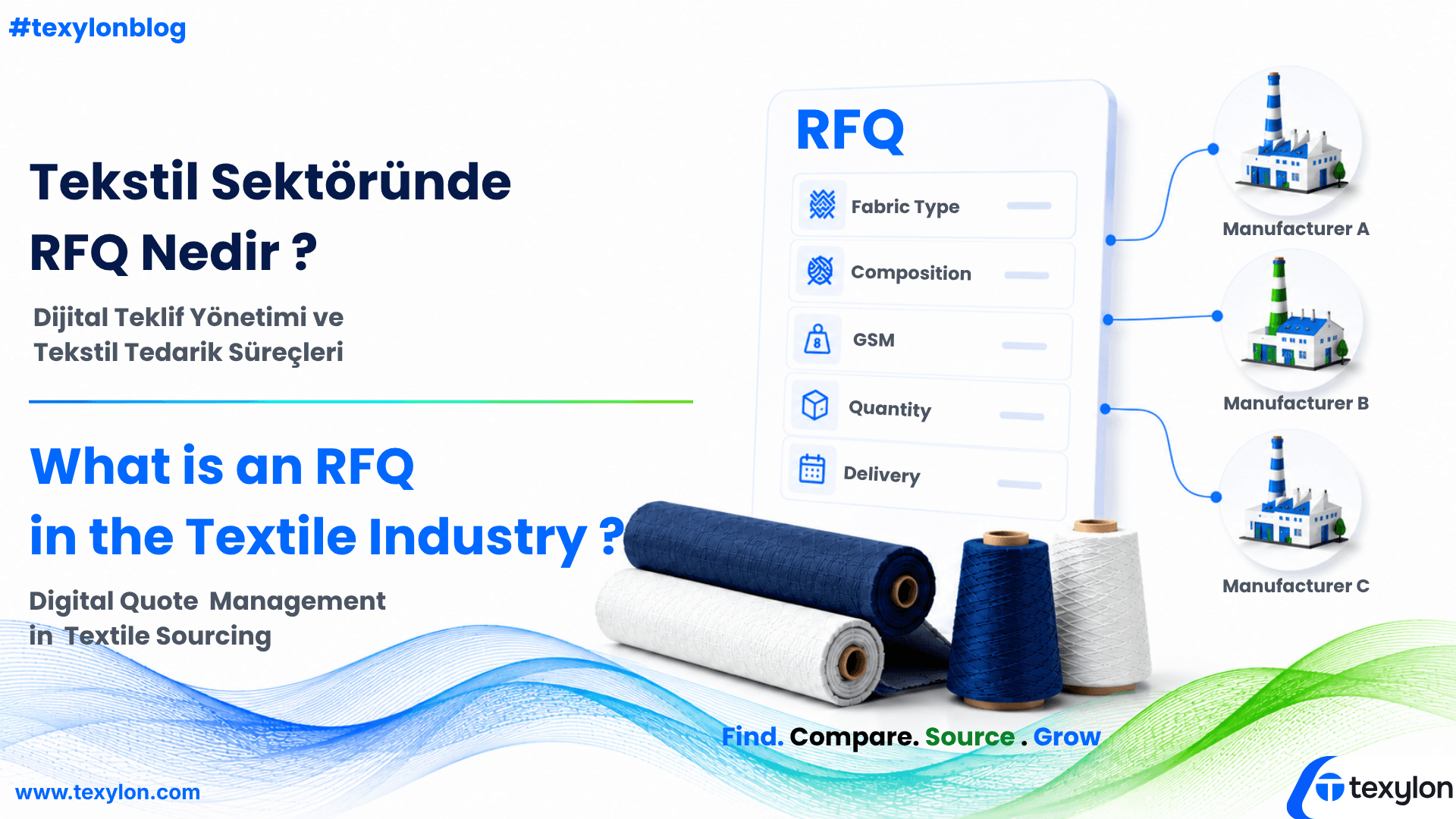
When generating an RFQ in the textile sector, the following information is typically disclosed:
Product category (Fabric, yarn, ready-to-wear, home textiles, accessories, etc.)
Fabric specifications
Weight (GSM)
Composition (100% Cotton, Polyester, Viscose, etc.)
Knit or weave type
Width information
Color and pattern details
Technical specifications
Certification requirements (OEKO-TEX, GOTS, GRS, BCI, etc.)
Minimum order quantity (MOQ)
Target order quantity
Sample request
Delivery date
Incoterms (FOB, CIF, EXW, etc.)
Delivery country or location
Payment terms
By virtue of this information, all manufacturers submit bids based on identical technical specifications. Consequently, price, quality, lead times, and manufacturing capacity can be compared objectively.
Why is RFQ So Critical for the Textile Industry?
The textile industry is a highly dynamic sector featuring thousands of diverse product classifications.
Dozens of manufacturers may exist for the same fabric. The identical product can be manufactured in different countries at varying price points. Consequently, procurement teams must evaluate multiple criteria concurrently, including quality, lead time, certification, manufacturing capacity, and logistics, rather than focusing solely on price.
A professional RFQ process:
Reduces procurement costs.
Enables access to a broader network of manufacturers.
Establishes alternative supplier options.
Mitigates supply risk.
Facilitates competitive pricing.
Expedites the decision-making process.
Ensures transparent procurement management.
Particularly in international textile trade, the utilization of RFQs has become a standard practice.
Challenges Encountered in Traditional RFQ Processes
In many textile firms today, quotation management is still conducted using manual methods. This situation leads to serious operational issues.
1. Uncontrolled Email Traffic
Quotations originate from various individuals. Some are received as PDFs, others in Excel format, and some as email text. Locating historical quotations days later can become exceptionally difficult.
2. Difficult-to-Compare Quotations
Each manufacturer utilizes a different format. One provides an FOB price, another CIF. Some omit the lead time, while others fail to specify the minimum order quantity. Consequently, conducting a sound analysis of the bids becomes highly challenging.
3. Accessing New Suppliers is Difficult
Many enterprises have been collaborating with the same manufacturers for years.
To identify new manufacturers, it is required to:
attend trade fairs,
conduct internet research,
gather references,
initiate lengthy email chains.
This process is both costly and time-consuming. As a consequence, firms frequently continue to work with their established suppliers. In the long term, this presents a significant supply risk.
4. Procurement Processes Take Unnecessarily Long
Requesting quotations, waiting for responses, sending reminders, compiling bids, comparing, and making decisions... The entire process can sometimes take days or even weeks. This situation presents a major disadvantage, particularly in the Fast Fashion sector.
What is Digital RFQ Management?
Digital RFQ management is a new-generation procurement approach that enables the bid collection process to be conducted via a single platform.
All quotations are compiled in a standardized format. Communication is centralized. Documents are not misplaced. Bids are analyzed with ease. Procurement teams acquire complete visibility throughout the process.
This approach offers significant advantages for both large textile manufacturers and small to medium-sized enterprises.
Digital RFQ Management with TEXYLON
TEXYLON is a global B2B textile platform and textile supplier network developed specifically for the textile industry.
Through the platform, buyer firms can generate an RFQ in just a few minutes and distribute it simultaneously to suitable manufacturers in different regions of the world.
With TEXYLON:
The RFQ generation process is completed within minutes.
Textile manufacturers in the correct category are reached automatically.
Incoming quotations are viewed in a standardized format.
Prices are easily compared.
Sample processes are monitored.
Supplier communications are managed from a single dashboard.
Procurement processes are digitalized.
RFQ history is securely archived.
Consequently, procurement teams can focus on strategic decision-making rather than operational tasks.
Advantages Provided by the TEXYLON RFQ System
Global Textile Supplier Network
Thanks to TEXYLON, you are not limited solely to your existing suppliers. You can reach verified textile manufacturers operating in different countries and obtain more competitive bids.
More Competitive Prices
Reaching multiple manufacturers with a single RFQ naturally stimulates price competition. This optimizes procurement costs.
Faster Procurement Process
Email traffic is reduced. Quotation waiting times are shortened. Decision-making is expedited. Orders can be generated in a shorter timeframe.
Standardized Bid Comparison
Every quotation is received in the identical format.
Consequently, price, quality, manufacturing capacity, certifications, lead times, and minimum order quantities can be easily analyzed on a single screen.
Discovering New Manufacturers
There are thousands of high-quality textile manufacturers in the global market. Thanks to TEXYLON, you can seize the opportunity to collaborate not only with your existing suppliers but also with new manufacturers. This enhances the sustainability of your supply chain.
Digital Supplier Management
Quotation histories, sample processes, communication records, and RFQ documents are stored on a single platform. This prevents the loss of corporate knowledge.
Who Should Utilize RFQs?
The RFQ system is not designed solely for large manufacturers. It provides substantial advantages for many businesses operating in the textile sector.
For instance:
Fabric manufacturers
Yarn manufacturers
Garment manufacturers
Fashion brands
Private Label manufacturers
Textile importers
Textile exporters
Fabric procurement teams
Sourcing departments
Product development teams
Procurement managers
Textile trading companies
Retail chains
Home textile manufacturers
Technical textile firms
RFQ management delivers significant efficiency, particularly for enterprises collaborating with a large volume of suppliers.
Why Digital Textile Sourcing Platforms Are Shaping the Future
The textile industry now competes not only on manufacturing but also on data and speed.
Enterprises seek to:
identify manufacturers more rapidly,
receive a higher volume of quotations,
reduce procurement costs,
establish alternative suppliers,
mitigate supply risk,
reach global manufacturers.
Accomplishing this through manual methods is becoming increasingly difficult each day.
Consequently, digital textile sourcing platforms, B2B textile marketplace solutions, and RFQ management systems are poised to become the new industry standards.
Conclusion
In the global textile industry, competitiveness is no longer determined solely by production capacity, but also by your procurement speed and your capability to reach the correct supplier.
Through digital RFQ management, quotation collection processes become faster, more transparent, and highly efficient. While reducing manual workload, procurement teams can reach a larger number of manufacturers, compare bids within a standardized framework, and make more accurate commercial decisions.
Texylon aims to facilitate global textile sourcing processes by connecting buyers and verified manufacturers on a single platform through its digital RFQ infrastructure developed specifically for the textile industry.
Identify the correct supplier faster. Receive more quotations. Digitalize your procurement processes. Expand your global textile network with Texylon.